
- News
- Basics
- Products
- JP Job shop
- Exhibition
- Interview
- Statistic
- PR
- Download
- Special contents



 Japanese Cutting-Edge
Solutions for Metalworking



Japanese Cutting-Edge
Solutions for Metalworking
Exhibition
December 3, 2025


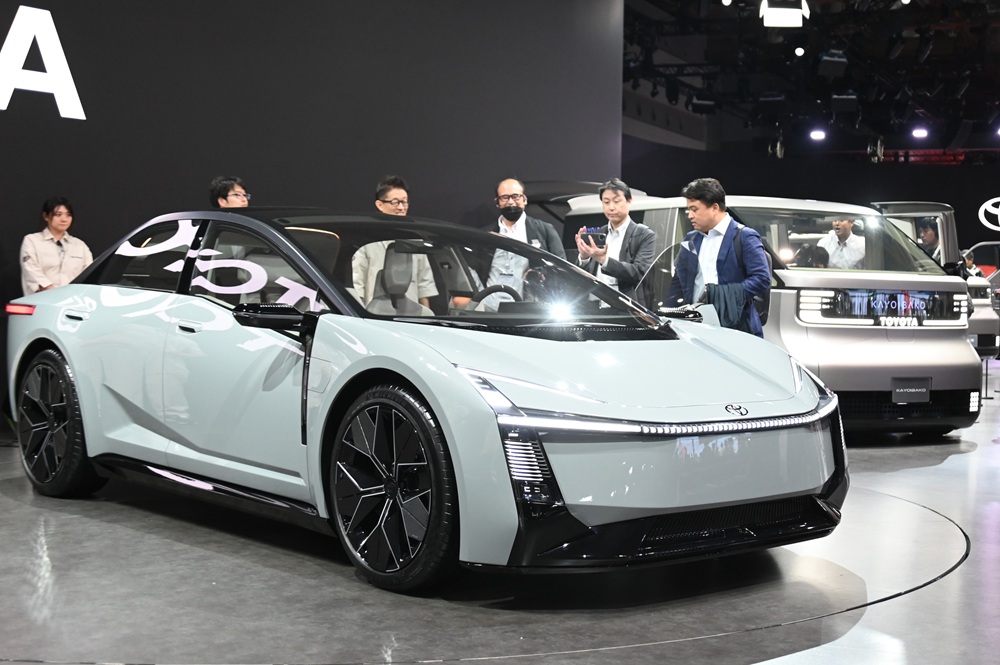
By: Masanobu Nishizuka, Staff Editor, SEISANZAI Japan
Japan Mobility Show (JMS) 2025 was held at Tokyo Big Sight in Koto-ku, Tokyo, from October 30 to November 9. Unlike the previous edition, which featured many conceptual battery electric vehicles (BEVs), this year’s show reflected each company’s unique philosophy and distinctive approach, particularly in powertrains.
This year’s show featured a record 522 exhibiting companies and organizations. Although attendance of 1.01 million was down about 10% from the previous edition due to renovation closures of East Halls 1–3, the venue was filled with energy.
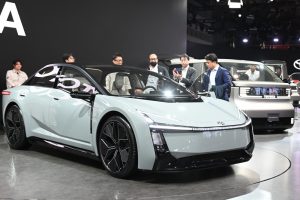
Toyota’s new Corolla embodies the company’s “multi-pathway” strategy.
Toyota Motor drew significant attention with its concept car for the flagship “Corolla” model, featuring a sportier design than the current model. True to the company’s “multi-pathway” strategy, the powertrain lineup is planned to include internal combustion engine (ICE), hybrid electric vehicle (HEV), plug-in hybrid electric vehicle (PHEV), and BEV options. President and CEO Koji Sato stated: “Corolla is ‘a car for everyone.’ The world is vast, with different roads and different energy situations. Whatever the power source, we will create a cool car that everyone wants to drive.”
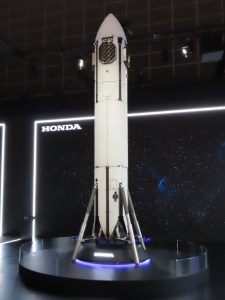
Honda displayed the actual test rocket successfully launched in June.
Honda lived up to the name of the “Mobility Show” with exhibits spanning multiple domains. Beyond automobiles like the “Prelude” launched in September and the “Honda 0” BEV series to be released sequentially from next year, the company displayed marine vessels, the “HondaJet” aircraft, and an actual test rocket launched in June this year. President and CEO Toshihiro Mibe stated: “We want to pursue the value of mobility across land, sea, air, and even space.”
Nissan Motor prioritized products scheduled for release within two years over concept vehicles, “given the recent business situation,” according to its public relations department. At the venue, President and CEO Ivan Espinosa, who has a background in product planning, passionately explained the appeal of the new BEV “Leaf,” a model he has strong attachment to.
China’s BYD demonstrated serious commitment to developing the Japanese market. The company plans to launch “RACCO,” a BEV kei-car height wagon popular in the domestic market, around summer 2026. The show also featured the “SEALIO 6 DM-i,” which is set to be released in Japan in December. It will be the company’s first plug-in hybrid electric vehicle (PHEV) for Japan. BYD showcased drivetrain models to highlight its proprietary control technologies.
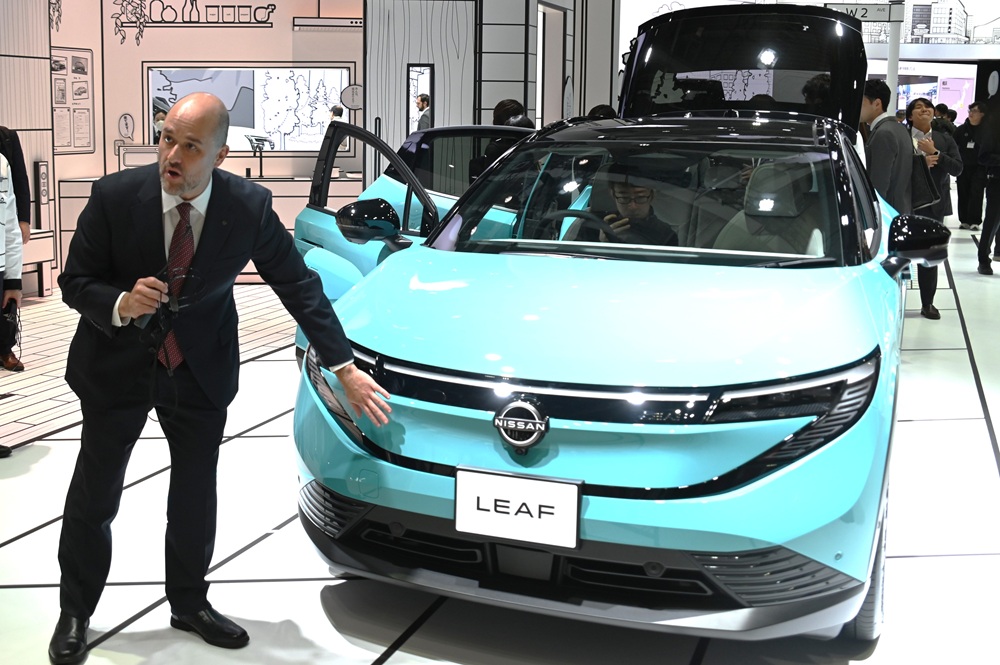
Nissan CEO Ivan Espinosa passionately explains key points of the new Leaf.
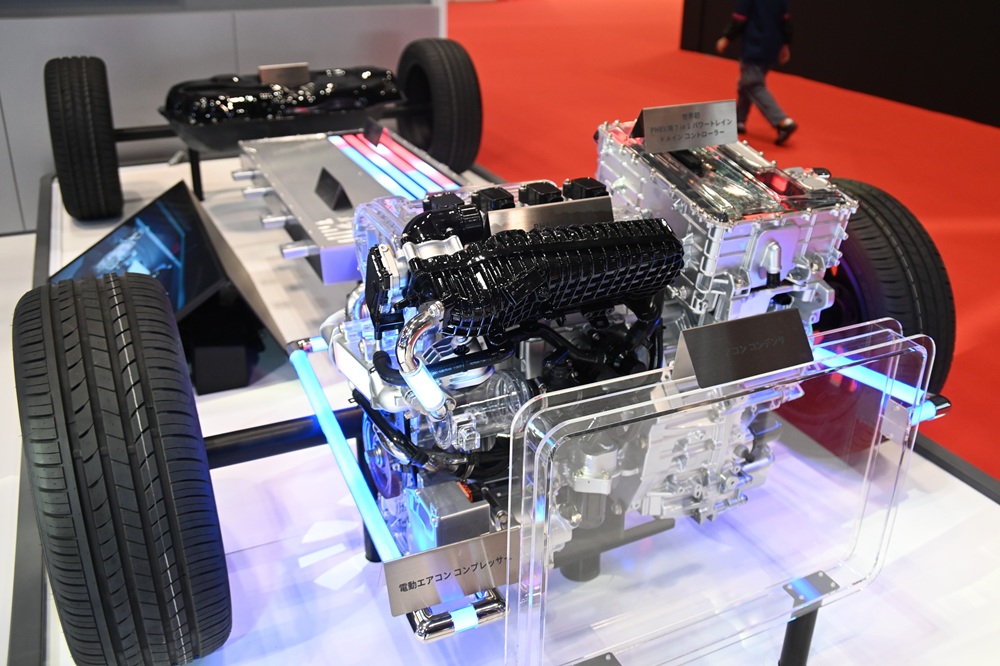
BYD showcased drivetrain and control system models for its PHEV.
Companies emphasizing unique fuel approaches also stood out. Suzuki is advancing a business in India to generate biomethane gas from cattle manure. Construction of up to five facilities is confirmed, with factory operations scheduled to begin sequentially from 2025.
Mazda introduced a concept of “reducing CO₂ the more you drive.” The company is developing biofuels derived from seaweed and algae. Mazda unveiled the “Mazda Vision X Coupe” PHEV equipped with a rotary engine powered by this energy source. The vehicle also features a CO₂ capture system that reduces CO₂ emissions while driving.
There were also prominent hydrogen-related proposals. Mitsubishi Fuso Truck and Bus exhibited two reference large trucks: the fuel cell vehicle (FCEV) “H2FC” using hydrogen fuel, and the “H2IC” with a hydrogen combustion engine. Yamaha Motor unveiled a hydrogen-powered motorcycle for the first time, indicating that hydrogen is becoming a viable option.
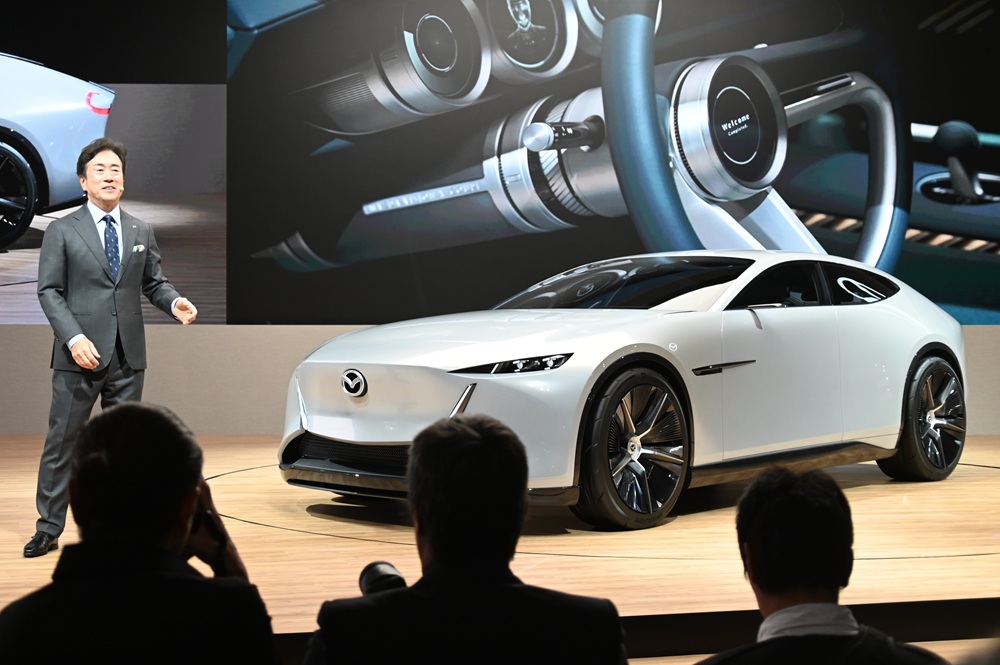
Mazda President and CEO Katsuhiro Moro introduces the “Mazda Vision X Coupe.”
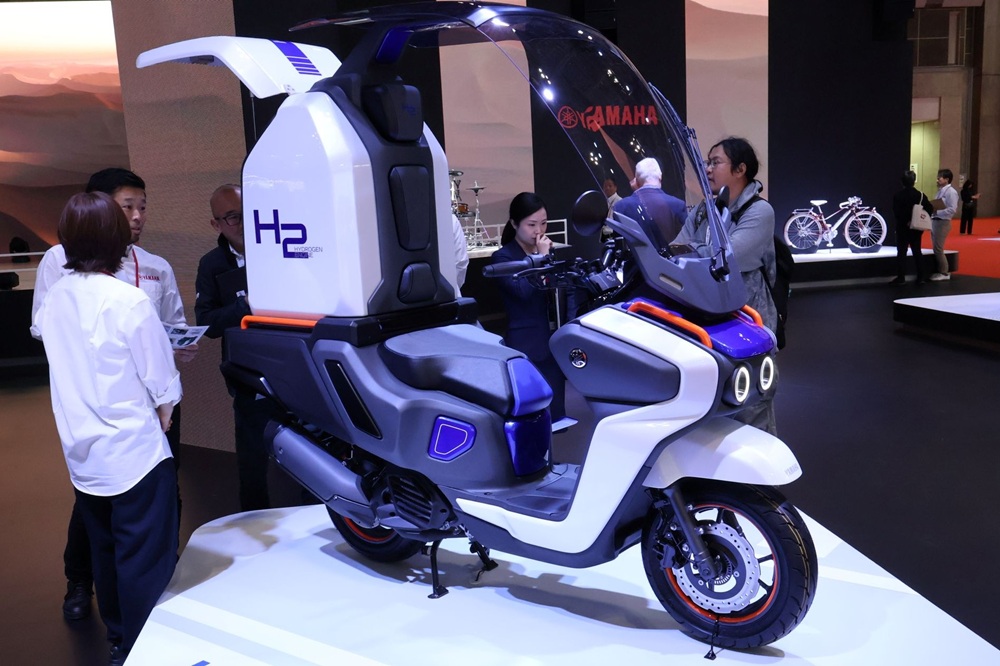
Yamaha Motor exhibited a concept motorcycle equipped with a hydrogen engine.
Automotive component advances were also noteworthy. Bridgestone exhibited “AirFree,” an airless tire. The company’s proprietary thermoplastic resin connects and supports the rubber section that contacts the road surface to the vehicle body. This resin can deform to absorb impacts. Due to the resin’s high mechanical properties, Bridgestone is verifying mass production methods.
Suspension and component manufacturer Yorozu promoted its weight reduction technology “GENNIKUN.” This technology partially stretches steel plates to achieve different tensile strengths and thicknesses within a single sheet. Proprietary know-how ensures stable quality during the stretching process.
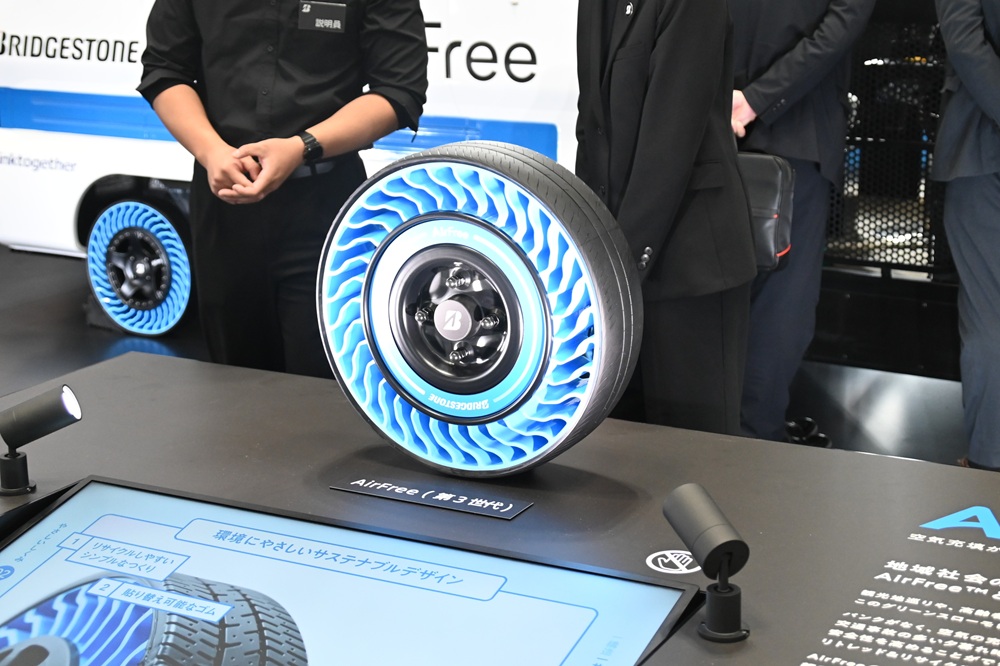
Bridgestone’s airless tire “AirFree”.
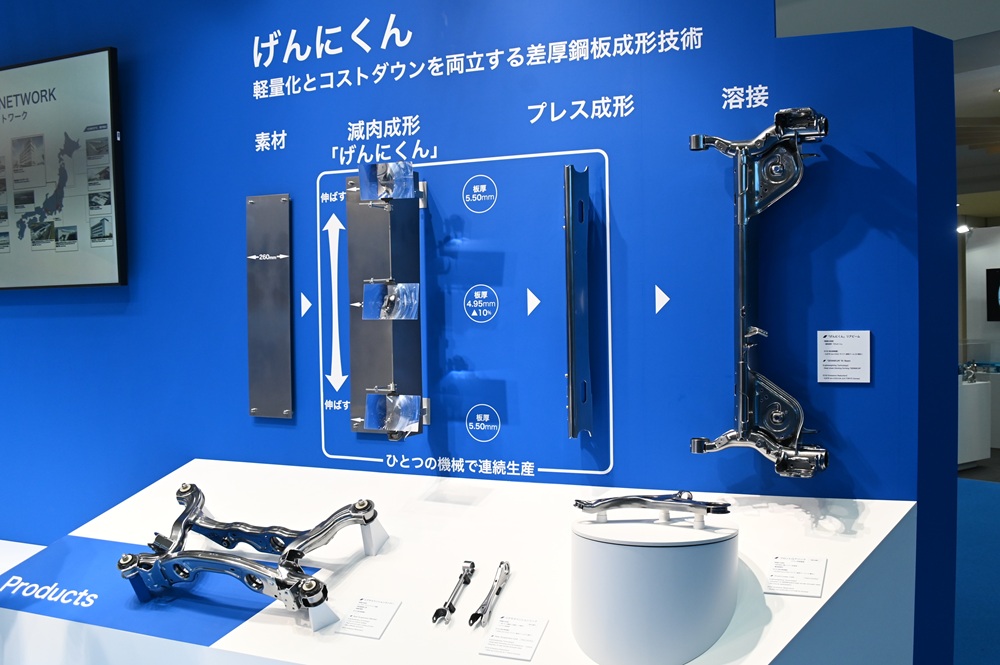
Yorozu introduced its weight reduction technology “GENNIKUN”.
Compared to the previous edition, this show featured fewer unrealistic concept models and more prototypes of new vehicles scheduled for release within two years. Power source options have also diversified beyond the previous BEV-centric approach. While realistic exhibits highlighted each company’s unique characteristics, approaches to the common ultimate goal of environmental response have become increasingly divergent.
This year’s show prompted renewed reflection on how capital goods manufacturers should respond to the expanding and diverse needs of automakers.
Share On :


