
- News
- Basics
- Products
- JP Job shop
- Exhibition
- Interview
- Statistic
- PR
- Download
- Special contents



 Japanese Cutting-Edge
Solutions for Metalworking


Japanese Cutting-Edge
Solutions for Metalworking
Interview
January 27, 2026


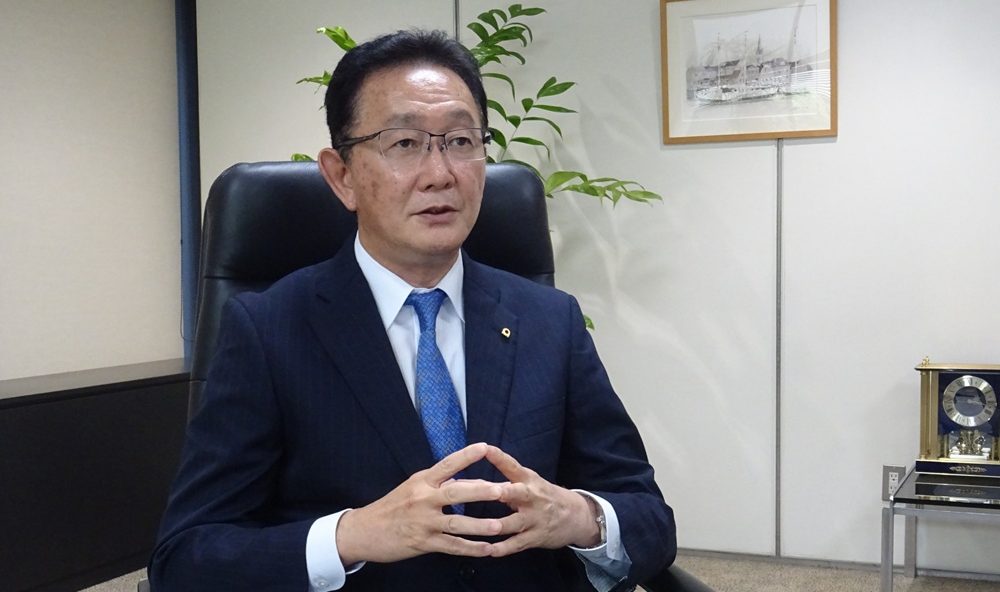
Interviewed by Shu Yasumi, Editor-in-Chief, SEISANZAI Japan
“Current orders are recovering and at record-high levels,” says President Takaaki Yamanashi. Markets worldwide are generally recovering, though with variations. AMADA is promoting automation and manufacturing innovation through technology development and proposals that anticipate customer needs. “From automation of individual processes to automation that connects processes,” Yamanashi describes this evolution in their approach. Following major mergers and acquisitions (M&A) in 2025, the company expects further growth in 2026.
Orders are recovering and at record-high levels. The U.S., where “manufacturing reshoring” is particularly prominent, is leading this trend. Demand related to energy-related sectors such as heavy electrical and power equipment, and demand related to data centers for artificial intelligence (AI), are remarkably active. Domestic demand in Japan is also improving, albeit gradually. In Asian markets, South Korea as an export-oriented country is not doing well, but Taiwan is recovering. India and Vietnam continue to perform well, and Thailand has bottomed out and is on a recovery trend.
Germany’s economy remains sluggish, which has a significant overall impact, and the UK and Eastern Europe are also not doing well. On the other hand, Italy and Spain continue to be in very good condition. Overall, despite regional variations, the market is generally on a recovery track. Regarding the Japanese market, the domestic market is on an upward trend partly due to subsidy effects, and we see bright signs for the coming fiscal year.
Customers in the U.S. market are “not overly cautious” compared to those in the Japanese market. When they move, they move big, and they are willing to invest with confidence they can recover their investment. The U.S. market used to focus solely on mass production, but gradually multi-product small-lot production has also increased. Their use of factory space has also changed—whereas they used to store materials flat on the floor using space generously, they are now emphasizing productivity per unit floor space, as manufacturers in Japan do, due to building constraints and rising labor costs. You could say they’re “fitting into Japanese manufacturing style.” In that sense, this is exactly a business opportunity for us.
We’re investing aggressively. Our Chicago Solution Center is undergoing a complete renewal with automation as the theme. We’re visualizing entire processes and deploying various proposals. In sheet metal processes, blanking and bending automation has progressed, but welding lags behind. With demand for welding automation rising due to skilled worker shortages, we’re actively proposing solutions to meet this need.
At a special event held at our headquarters in November, we promoted welding process automation under the theme of “Welding DX (Digital Transformation).”
We showcased welding process automation using not only conventional industrial robots but also collaborative robots, along with factory-wide visualization and automation using our manufacturing DX solution “LIVLOTS.” Customers have received this enthusiastically.
By “connecting” processes and “visualizing” them, we can streamline overall production. This leads to customer understanding and acceptance. We’ve been working on advanced development to anticipate customer needs. We’re promoting this at the AMADA Global Innovation Center (AGIC). This is the practice of AGIC’s concept: “A place for Co-creating the future of metalworking.” It’s also important to horizontally deploy AGIC’s concept to solution centers and technical centers worldwide. Global deployment will take three to four years, but we’ll expand sequentially to India, Thailand, Italy, and other locations.
We will complete our current medium-term management plan in fiscal 2025 and announce a new plan next fiscal year. First, we’ve been steadily accumulating efforts to achieve the current plan’s targets, and we’re also making steady progress in preparing the new plan. We should be able to realize even more benefits from M&A acquisitions like H&F for large press machines and Via Mechanics for printed circuit board drilling machines. We’ll integrate the technologies our group possesses and provide products and technologies to the new markets we’ve acquired. Markets of particular focus are semiconductors, electric vehicles (EVs), and medical fields. We’re steadily preparing, and I’m looking forward to 2026.
AMADA has previously focused on automating cell production in individual processes. Currently, we’re also focusing on automation that connects processes, using autonomous mobile robots like “AMTES.” This is what customers will require going forward. While cell production can improve productivity through multi-machine handling, the reality is that surprisingly much manual work is needed outside cells. We must make proposals that respond to customers seeking solutions for labor shortages, skill succession, and further productivity improvements.
In 2026, the economy will change significantly depending on U.S. tariff policy. The impact on Japan as an export country will be large, and if tariffs remain at current levels, we can expect recovery at or above current levels. We’re also shifting to flexible production to minimize the impact, considering exchange rates and geopolitical risks. The U.S. market is currently strong, and according to our U.S. representatives, the outlook for 2026 and beyond is even better. The European market will also gradually improve. In the Chinese market, where we’ve clarified our high-end strategy, we’re not pursuing volume, and our strategic shift has turned sales revenue positive.
We’re planning events centered on AGIC. This fiscal year, we expect to ultimately reach sales revenue of 440 billion yen. The current strong order situation will take effect from next fiscal year onward. Our balance sheet will also improve. We’ve received feedback from investors that we “should reduce inventory,” but we need to carefully manage inventory levels so that we can deliver products to customers without delay in the strong U.S. market. We want to properly differentiate by market, and that becomes our strategy. A current challenge is that lead times tend to lengthen for larger projects. If system upgrades accompanying automation demand become standard, we must pursue modular production of peripheral equipment even more vigorously.
 Profile: Takaaki Yamanashi
Graduated from Aoyama Gakuin University Faculty of Science and Engineering in 1987 and joined AMADA. President of AMADA Advanced Technology (Germany) in 2016, Senior Executive Officer and General Manager of Blanking Machinery Development Division in 2018, Managing Executive Officer in 2021, Senior Managing Executive Officer in 2022. Assumed current position in 2023. Born in Kanagawa Prefecture in 1963, age 62.
Share On :


