
- News
- Basics
- Products
- JP Job shop
- Exhibition
- Interview
- Statistic
- PR
- Download
- Special contents



 Japanese Cutting-Edge
Solutions for Metalworking



Japanese Cutting-Edge
Solutions for Metalworking
News
February 13, 2026


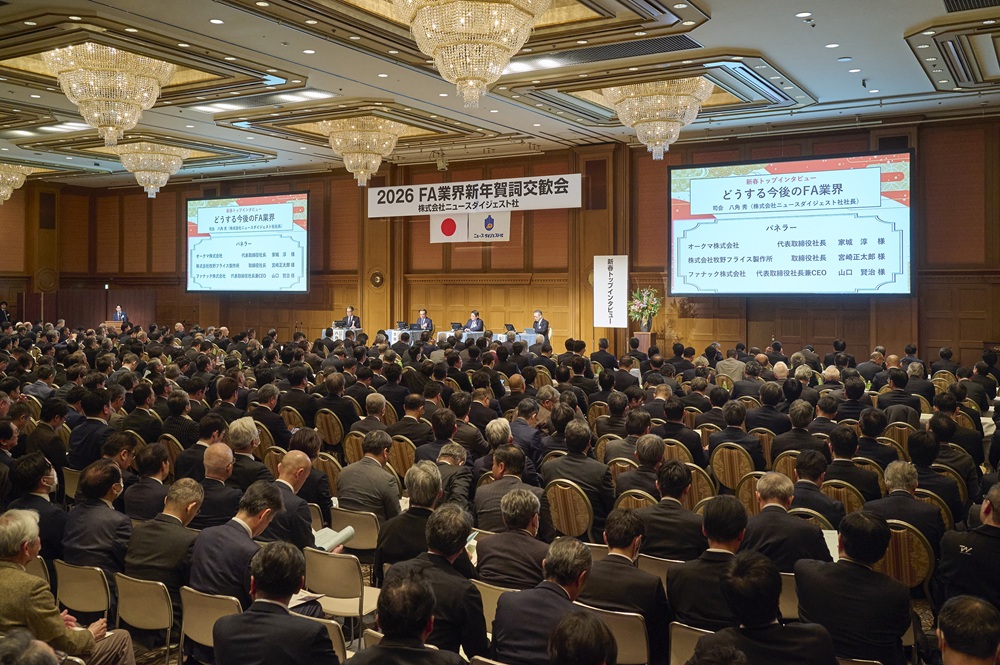
Industry leaders discuss automation, labor shortages, and AI strategies
At the 2026 FA Industry New Year’s Reception, hosted by News Digest Publishing (ND), the signature “New Year Top Executive Interview” featured three industry leaders in an in-depth discussion under the theme “What to Do About the Future of the FA Industry.” The panel included Dr. Atsushi Ieki, President of Okuma; Shotaro Miyazaki, President of Makino Milling Machine; and Kenji Yamaguchi, President and CEO of FANUC. The session was moderated by Dr. Shu Yasumi, President of News Digest Publishing. The following is an excerpt from their discussion.
Related article: 2026 FA Industry New Year’s Reception draws 755 attendees
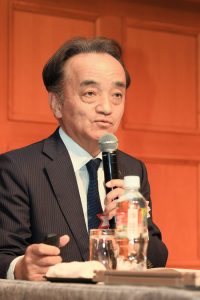 “Cloudy with occasional sunshine” — Okuma President Ieki
 I think this year’s FA industry will be “cloudy with occasional sunshine.” However, there may be sudden “earthquakes” or storms along the way. Looking back at last year’s order environment, the domestic demand ratio fell to a record low of 27-28%. Therefore, how to revitalize domestic demand is a critical theme for this year.
As of September last year, the World Economic Forum had recognized 201 facilities worldwide as “Lighthouse” advanced factories. Regionally, China has 84 such facilities, while Japan has only three. In Japan, production equipment that has been in operation for more than 20 years accounts for 35.4% of all equipment. Compared to China, capital investment is clearly insufficient. This year should mark a real turning point for Japan in revitalizing domestic manufacturing, including reshoring initiatives.
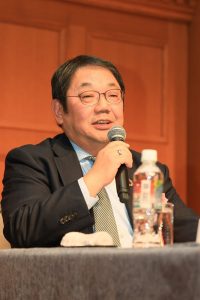 ISA-95 integrated with IT and OT — Makino President Miyazaki
 The international standard ISA-95 for integrating enterprise systems and factory control systems presents a pyramid model showing production roles at each level from management to the manufacturing floor. At our company, we are advancing factory automation and efficiency by combining IT and OT (operational technology) with the ISA-95 concept. We predict that the manufacturing floor level, which was previously divided into machine tools and processing lines, will become flatter in the future as IT and OT converge.
Ultimately, we should aim for smart factories where machine tools make autonomous decisions and can operate without stopping even without human presence. To achieve this, the development and enhancement of optimal scheduling functions, autonomous machine tools, OT technology, and communication technology are essential.
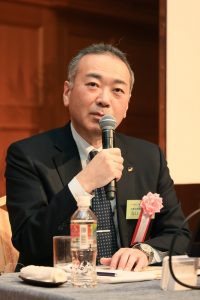 Addressing labor shortages — FANUC President and CEO Yamaguchi
 Japan’s working-age population is projected to decline by about 6.44 million by 2030 and by roughly 11 million by 2040. How to cover this serious labor shortage is an important theme going forward, and our company is working to solve this challenge through CNC and industrial robots.
In the CNC domain, we are pursuing further automation by advancing process integration, collaboration with robots, and improved reliability. We are also working on developing CNC as a platform and leveraging Internet of Things (IoT) technology.
Industrial robots will continue to be used for productivity improvement and liberation from 3K (kitsui, kitanai, kiken—strenuous, dirty, dangerous) work. Meanwhile, collaborative robots and intelligent technologies are expected to contribute solutions in areas where traditional industrial robots find automation difficult.
Our company practices extremely high-mix, low-volume production and has worked to improve productivity by combining IT and OT with the ISA-95 concept I mentioned earlier. Previously, we applied “Dynamic Scheduling,” a production schedule we developed in-house, with the goal of maximizing machine tool production efficiency. However, against the backdrop of increasingly serious labor shortages, we switched several years ago to “Proactive Scheduling,” a production schedule that focuses on human work efficiency.
Based on the know-how cultivated there, we developed the software “MAS-NX.” We are also proposing this to customers as a solution originally developed to address our own challenges.
For CNC, we are strengthening our use of digital twins and artificial intelligence (AI). With digital twins, we aim to reproduce machine tool behavior as faithfully as possible in digital form. As for AI utilization, we are first working on applying machine learning to analyze physical phenomena. Going forward, we will also advance the integration of digital twins and generative AI.
Regarding industrial robots, we have expanded our lineup by developing a 3kg payload collaborative robot. We have also renewed our main large robot models and enhanced their functionality. We are also enhancing support for open platforms and accelerating the implementation of “Physical AI,” which uses AI to operate robots autonomously.
We want to achieve innovation in manufacturing by combining Japan’s strength in machine tools with AI.
Our company provides autonomous machine tools equipped with proprietary intelligence technology and AI technology on highly stable machine tools. We clearly distinguish between intelligence technology and AI technology: intelligence technology makes highly reliable judgments based on theory, while AI technology makes flexible judgments based on data.
Both intelligence technology and AI technology must avoid becoming black boxes. Therefore, we visualize phenomena that occur during machining, such as chatter vibration, through waveform diagrams and present them to users.
November 4, 2025
December 25, 2025
Share On :


