
- News
- Basics
- Products
- JP Job shop
- Exhibition
- Interview
- Statistic
- PR
- Download
- Special contents



 Japanese Cutting-Edge
Solutions for Metalworking



Japanese Cutting-Edge
Solutions for Metalworking
News
April 22, 2026


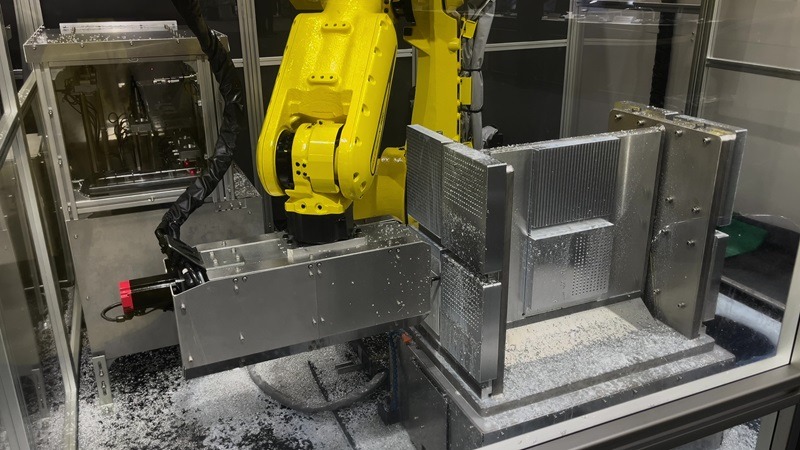
Robot machining — the use of robots equipped with spindles and cutting tools to process metal workpieces — is gaining traction in Japan as a cost-effective alternative to large machine tools. Driven by the rise of giga casting in the automotive sector, new entrants including machine tool builders and system integrators are accelerating both product development and market expansion.
Robot machining (also called robotic machining) is a manufacturing process in which an industrial robot fitted with a spindle and cutting tools performs material removal on metal workpieces — tasks traditionally handled by large machine tools.
These systems are particularly suited for:
・Light cutting of large aluminum alloy workpieces
・Applications where tight dimensional tolerances are not required
・Factories seeking compact, lower-cost alternatives to gantry machining centers
Rather than replacing conventional machine tools, robot machining systems complement them — addressing the requirements that large machines were never well-suited to handle.
The rise of robot machining reflects several converging trends in the manufacturing sector:
・Cost and space constraints — Gantry machining centers are expensive and require large installation footprints, making them inaccessible for many manufacturers.
・Giga casting adoption — The automotive industry’s shift toward large one-piece aluminum components is generating more workpieces that align with robot machining’s strengths.
・Overspecification concerns — For workpieces with modest tolerance requirements, a gantry machining center delivers far more precision than needed; robot machining offers a more proportionate solution.
Taken together, these factors are opening a distinct market segment that conventional machine tools have not served well.
At iREX 2025 (International Robot Exhibition), held in Tokyo last December, robot machining demonstrations at multiple exhibitor booths attracted considerable visitor interest — a visible sign of the momentum building around this technology in Japan.
While European suppliers held an early lead in this space, Japanese companies are now entering in growing numbers. Machine tool builders and automotive-focused system integrators have been investing in new product and system development, bringing fresh competition to the field.
Looking ahead, several robot machining systems are expected to be exhibited at ROBOT TECHNOLOGY JAPAN (RTJ) 2026, scheduled for June in Aichi Prefecture.
SEISANZAI Japan will be examining three companies at the forefront of this field — Sugino Machine, SAKURAI, and TRI ENGINEERING — in upcoming articles.
In the automotive industry, one of the main user sectors for both robots and machine tools, new manufacturing technologies such as giga casting are expanding. These processes increase the number of large aluminum components, which are suitable for robot machining.
While European companies initially led this field, new entrants have recently increased in Japan. These include machine tool manufacturers and system integrators with strengths in the automotive sector, and they are actively developing new products and systems.
At ROBOT TECHNOLOGY JAPAN (RTJ) 2026, scheduled to be held in Aichi Prefecture in June, multiple robot machining systems are expected to be exhibited.
Robot machining is positioned not as a replacement for conventional machine tools but as a complementary solution. As manufacturing processes diversify and large workpieces become more common, the role of such systems is likely to expand in areas where flexibility and cost efficiency are required.
Share On :


