
- News
- Basics
- Products
- JP Job shop
- Exhibition
- Interview
- Statistic
- PR
- Download
- Special contents



 Japanese Cutting-Edge
Solutions for Metalworking



Japanese Cutting-Edge
Solutions for Metalworking
News
May 7, 2026


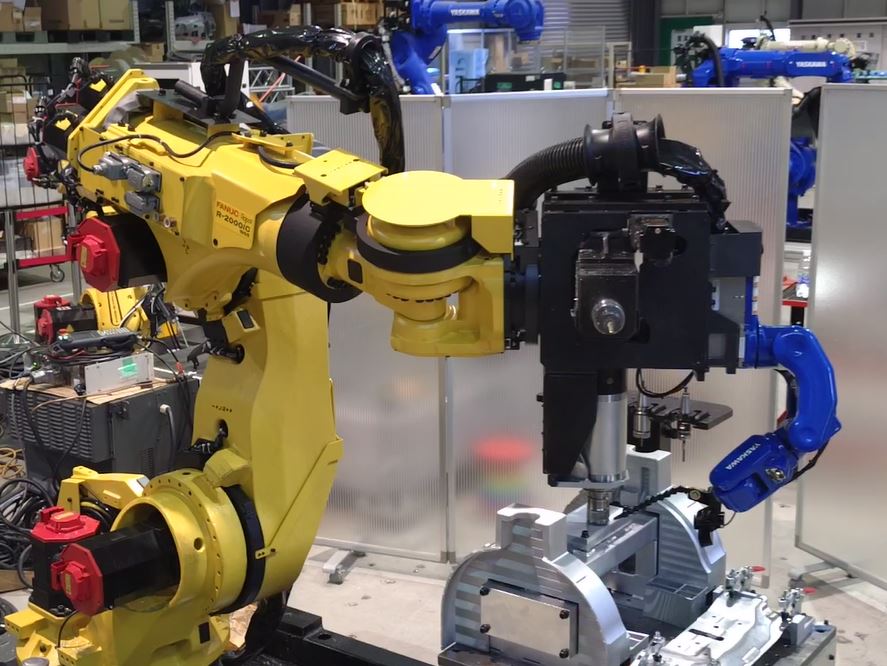
TRI ENGINEERING, a Nagoya-based robot system integrator, has been building robot machining systems since 2014 and has delivered more than 50 units across automotive, aerospace, railway, shipbuilding, and steel applications. The company differentiates itself by not being bound by the conventions of machine tool manufacturing — keeping system configurations simple and tailoring each solution to the customer’s actual accuracy and cost requirements.
The Robot Machining System, with a cumulative delivery record of 50 units (Photo: TRI ENGINEERING)
TRI ENGINEERING’s Robot Machining System is built around a proprietary in-house-developed spindle motor and is designed for large workpiece applications across a range of industries. Unlike systems that incorporate high-rigidity beds or high-accuracy jigs typical of precision machining environments, TRI ENGINEERING’s approach prioritizes simplicity — configuring each system around what the customer’s application actually requires.
The system addresses a practical gap in the market: manufacturers that need to process large workpieces but cannot justify the cost or floor space demands of gantry machining centers or five-face machining centers.
While robots generally lag behind machine tools in machining accuracy and speed, they offer advantages in flexibility, footprint, and cost. Inquiries for TRI ENGINEERING’s Robot Machining System have increased sharply over the past few years. Two factors are driving this:
– Giga casting adoption — The emergence of large one-piece aluminum components in automotive manufacturing is creating new applications well-suited to robot machining.
– Robot technology advances — Higher-rigidity robots and improvements in absolute positioning accuracy are expanding what robot machining can realistically deliver.
Heavy-cutting applications have also been increasing, and test machining requests remain frequent, indicating growing interest in applying robot machining to a wider range of work.
As more companies enter the robot machining field in Japan, TRI ENGINEERING differentiates itself through its approach as a robot system integrator. “Because we are a system integrator, we are not bound by the ‘common sense’ of machine tool manufacturers,” said Senior Managing Director Takeharu Oka. “We can propose a Robot Machining System that is right-sized for the accuracy and cost requirements each customer actually has. That willingness to think unconventionally is what defines us.”
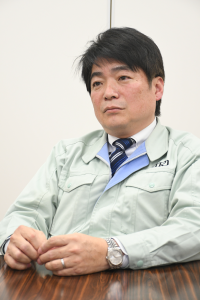
Takeharu Oka, Senior Managing Director of TRI ENGINEERING, who also serves as chairman of the Robot Machining Technology Symposium
TRI ENGINEERING has been active in robot machining since 2014 — well before the current wave of new entrants. Oka also serves as chairman of the Robot Machining Technology Symposium, an industry body co-founded in 2024 with robot manufacturers, cutting tool makers, and others in the field.
The group currently has 13 members including associate members, up from 8 founding members, as of March 2025. Its focus is on pooling technical knowledge and raising the baseline capability of robot machining across the industry.
“There are still many unresolved technical questions in robot machining — around robots themselves, cutting tools, machining conditions, and more,” said Oka. “If we can work through these one by one, the market will grow significantly.”
TRI ENGINEERING’s approach highlights the role of system integrators in robot machining. By focusing on flexible system design rather than standard configurations, the company proposes solutions tailored to customer requirements.
Share On :


