
- News
- Basics
- Products
- JP Job shop
- Exhibition
- Interview
- Statistic
- PR
- Download
- Special contents



 Japanese Cutting-Edge
Solutions for Metalworking


Japanese Cutting-Edge
Solutions for Metalworking
News
February 9, 2026


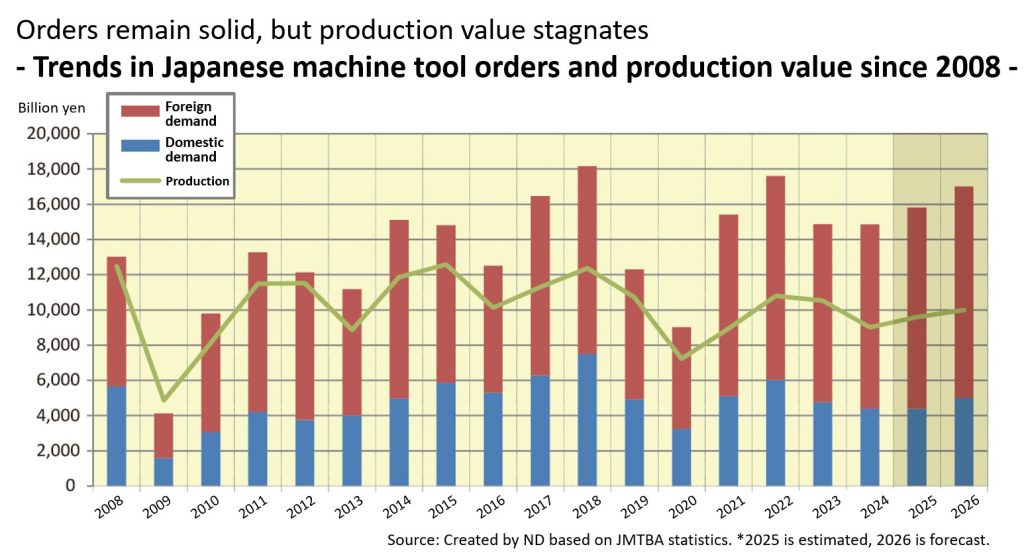
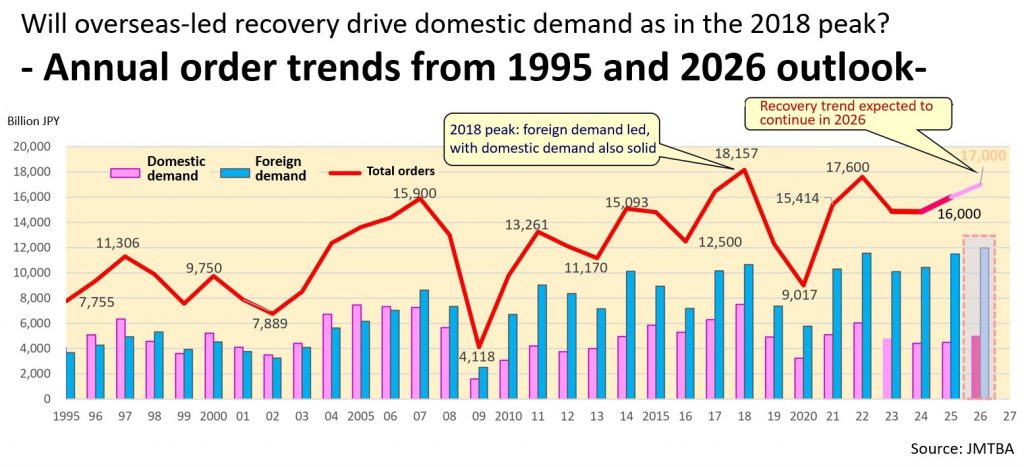
Both News Digest Publishing (ND) and the Japan Machine Tool Builders’ Association (JMTBA) have forecasted machine tool orders of JPY 1.7 trillion for 2026, representing a 7.6% year-on-year (YoY) increase. While multiple risks loom over the global economy, both organizations still expect active demand, driven by overseas markets and supported by domestic policy measures.
Related article: 2026 FA Industry New Year’s Reception draws 755 attendees

Dr. Shu Yasumi, President and Editor-in-Chief of ND/SEISANZAI Japan
“The JMTBA’s monthly average order value in 2025 remained at a high level of JPY 130 billion. However, the actual business sentiment is far removed from these headline figures. The biggest source of difficulty is weak domestic demand. Additionally, inflation has driven up procurement costs, raising manufacturing costs and squeezing profits,” said Dr. Shu Yasumi, President and Editor-in-Chief of ND/SEISANZAI Japan, in presenting the “Industry Outlook.”
For 2026, ND forecasts total orders of JPY 1.7 trillion, up 7.6% YoY. The breakdown includes domestic demand of JPY 500 billion (up 13.6% YoY) and foreign demand of JPY 1.2 trillion (up 5.3% YoY).
While overall economic growth is expected to slow this year, President Yasumi believes that the more protectionism and fragmentation advance globally, the higher equipment demand will rise. For domestic demand, ND expects support from various government policies. For foreign demand, ND anticipates overall strength bolstered by a weaker yen, setting targets higher than last year.
President Yasumi identified seven risks affecting the JPY 1.7 trillion target:
1. Will the weak yen continue? While the weak yen has boosted order values, “factors are complex, including the interest rate differential between Japan and the U.S. We must be careful as the yen could strengthen,” Yasumi noted.
2. Unstable and uncertain international situation – International relations remain opaque, with the U.S. detaining Venezuelan President Maduro in early January. Strategic materials like rare metals are heavily influenced by national policies.
3. Trump administration policies and reshoring in the U.S.
4. Chinese government economic support measures
5. Rise of emerging and promising markets
6. Automotive product mix changes
7. Will semiconductor investment beyond generative AI materialize?
At the same time, although orders in 2025 were on a recovery trend, production value failed to grow. During boom periods, production reaches around JPY 1.2 trillion, but last year it remained at approximately JPY 1 trillion. Without increasing production value, the difficult business sentiment cannot be overcome.
President Yasumi outlined three key points for surviving 2026:
1. In an inflationary era, growth is the only option – “In an inflationary environment, companies must use more, earn more, save more, and grow as organizations to survive,” Yasumi stated.
2. Stay close to quality customers – Rather than broad categories like regions or industries, companies need to identify and meet the expectations of multiple good customers.
3. Converge on ‘product excellence’
The presentation materials (in Japanese) are available for free download from ND’s website (www.news-pub.co.jp).
JMTBA Chairman Shigetomo Sakamoto
JMTBA estimated total 2025 machine tool orders at JPY 1.58 trillion at the time of the reception. The final figures announced on January 27 confirmed total orders at JPY 1.6043 trillion, up 6.4% YoY—the first positive YoY growth in three years.
After peaking with pent-up demand from the COVID-19 pandemic in 2022, investment in electric vehicles (EVs) and semiconductors stagnated, resulting in a stop-and-go pattern in capital investment. However, 2025 saw China revive through subsidy policies and North America perform strongly overall. Foreign demand approached the record JPY 1.1563 trillion set in 2022. Domestic demand remained flat and challenging, with foreign demand driving the first YoY increase in three years.
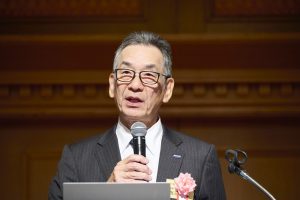
JMTBA Chairman Shigetomo Sakamoto (President of Shibaura Machine) reflected: “While Chinese subsidy policies and EV and IT-related demand provided support, the domestic market continued to face difficult conditions due to investment restraint in the automotive sector.”
For 2026, JMTBA forecasts total machine tool orders at JPY 1.7 trillion, matching ND’s projection. The breakdown also aligns: domestic demand at JPY 500 billion and foreign demand at JPY 1.2 trillion.
“If achieved, this would be the third-highest level on record. The first half of this year will likely see conditions similar to current levels, with recovery movements becoming clearer in the second half,” Chairman Sakamoto stated.
While the global economy faces uncertainties including trade friction and geopolitical risks, overall moderate positive growth is expected to continue. Both domestic and foreign demand have many positive factors for the latter half of the year.
For domestic demand, over 60% of Japan’s machine tools have been in use for more than 10 years. The latest equipment offers high energy-saving benefits and qualifies for subsidies under the government’s “Basic Energy Plan.” JMTBA expects replacement demand utilizing these subsidies. Additionally, priority investment in 17 fields as part of growth strategy should support active investment in replacing aging equipment.
For foreign demand, investment-promoting tax systems are being introduced in Europe and the U.S., China continues subsidy policies, and India’s rapid growth remains solid.
Chairman Sakamoto stated: “Japanese manufacturers face challenges including labor shortages, energy conservation, and productivity improvement. To address these, replacing aging machinery—resolving the so-called ‘vintage problem’—should be the top priority. We want to leverage government support measures and work together with user industries to strengthen the international competitiveness of Japanese manufacturing.”
January 21, 2026
January 27, 2026
January 30, 2026
Share On :


