
- News
- Basics
- Products
- JP Job shop
- Exhibition
- Interview
- Statistic
- PR
- Download
- Special contents



 Japanese Cutting-Edge
Solutions for Metalworking



Japanese Cutting-Edge
Solutions for Metalworking
News
March 3, 2026


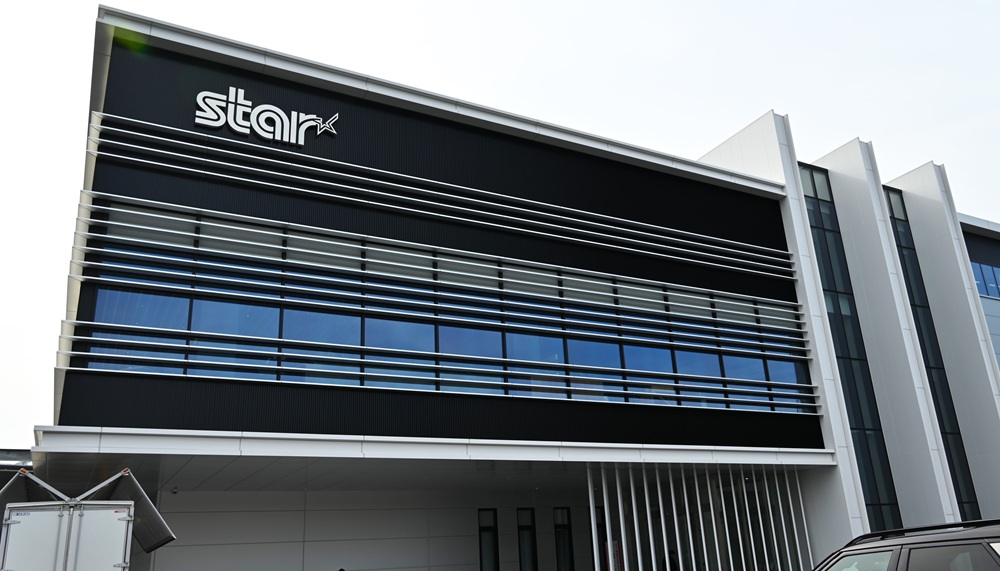
Star Micronics held a completion ceremony on February 5 for the “Kikugawa-Minami Factory,” constructed within its factory site in Kikugawa City, Shizuoka Prefecture. As global demand for automatic lathes expands due to growing needs for small parts machining, the company aims to increase automatic lathe production by expanding spindle manufacturing capacity. With this expansion, annual automatic lathe production is expected to increase by approximately 30% compared to previous levels, reaching about 7,000-8,000 units.
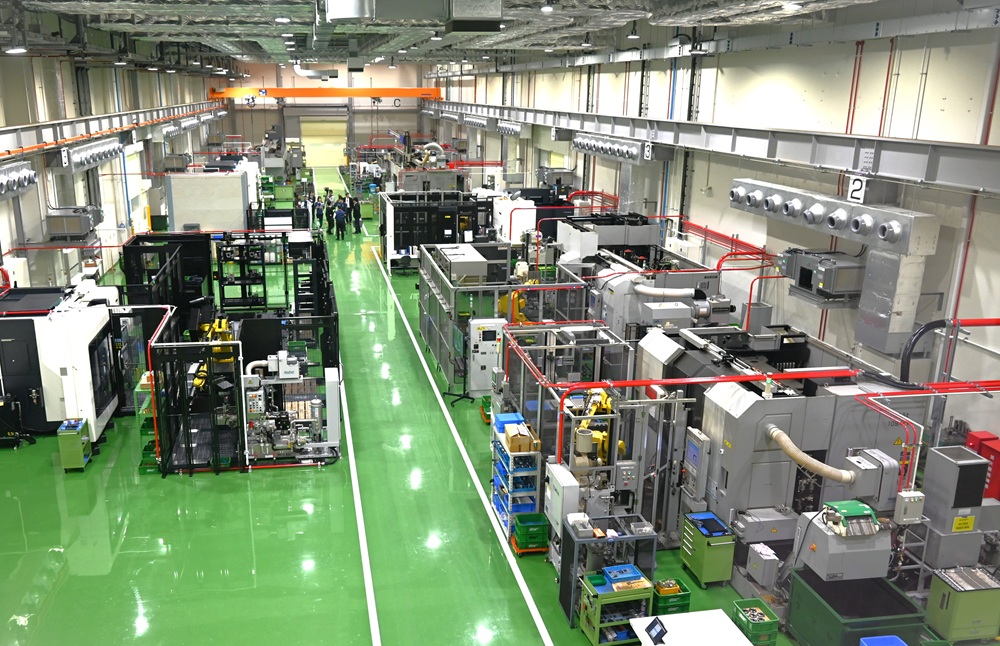
Visitors can observe the manufacturing floor from the second floor of the new factory.
Star Micronics held the completion ceremony for the Kikugawa-Minami Factory, which began operations in December last year. The three-story building has a total floor area of approximately 13,700 square meters, representing an investment of about JPY 10 billion. By expanding spindle production capacity, the company will increase annual automatic lathe production by approximately 30% to 7,000-8,000 units.
The factory’s first floor handles machining of round parts centered on spindles and flat parts such as tool posts. The second floor features a lounge equipped with a cafeteria and multipurpose space. The third floor serves as a shared workspace for the development and manufacturing departments, promoting cross-departmental communication and enabling product development that incorporates manufacturing perspectives. The facility received high ratings from two environmental certifications and installed solar panels, achieving a 111% reduction in primary energy consumption compared to conventional facilities.
President Mamoru Sato stated: “Demand for machining small parts is growing in medical, humanoid, and data center applications, causing global demand for automatic lathes to surge. To meet this demand, we first established a system to expand spindle production capacity.”
Inter-process transport is automated using AMRs equipped with collaborative robots.
At the factory tour held after the completion ceremony, the manufacturing floor was opened to major business partners and the press. As new equipment, the company installed a process-integrated machining line combining multi-tasking turning centers and combined cylindrical grinding machines. For inter-process transport within the line, the company introduced autonomous mobile robots (AMRs) equipped with collaborative robots, automating processes from spindle threading to outer and inner diameter grinding, cleaning, and inspection.
The company is also working on digital transformation (DX) of the manufacturing floor. A manufacturing support system visualizes data including work procedures, performance, inspections, and quality records. The facility also adopted a scheduler that automatically formulates production schedules suited to multi-product machining environments.
The company has production bases in China and Thailand. These are primarily assembly factories, with domestic factories responsible for producing core components like spindles. The newly established machining line currently automates the manufacture of 2-3 spindle product types. Going forward, the company plans to sequentially expand the range of automated products, with an eye toward adding similar lines.
President Sato emphasized: “If we proceed with updating aging equipment in the new factory and expanding the assembly factory, reaching annual production of 10,000 units is not a dream.”
September 30, 2025
December 2, 2025
Share On :


