
- News
- Basics
- Products
- JP Job shop
- Exhibition
- Interview
- Statistic
- PR
- Download
- Special contents



 Japanese Cutting-Edge
Solutions for Metalworking



Japanese Cutting-Edge
Solutions for Metalworking
News
June 10, 2026


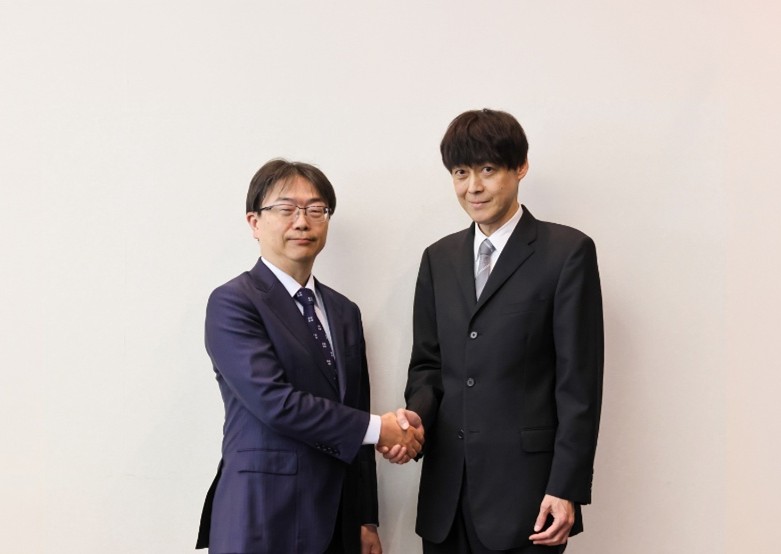
Mitsubishi Electric and Chiba Institute of Technology have signed a basic agreement to jointly research and develop Japan-made physical AI technology for applications in the public and private sectors. Under the agreement, the two parties will establish a co-creation center and promote the commercialization of AI robotics solutions using a wide range of autonomously controlled robots, including multi-legged robots, humanoid robots, and drone robots. The agreement will run for three years until April 2029.
In recent years, against a backdrop of declining working-age populations and the aging of public infrastructure such as roads, railways, and water supply systems, automation and efficiency improvements using AI and robotics have been advancing rapidly in manufacturing, as well as in infrastructure maintenance and inspection operations. However, tasks that require flexible responses to changing conditions — such as machining, assembly, and equipment adjustment on the factory floor — remain difficult to automate.
Physical AI, which enables real-time control suited to changing conditions, is attracting growing attention as a solution to these challenges. Physical AI has the potential to serve as a foundational technology for realizing autonomously controlled robots capable of handling tools with the dexterity of a skilled worker.
Mitsubishi Electric brings extensive knowledge cultivated across diverse business fields, including manufacturing and infrastructure maintenance and inspection. Through the development of factory automation products such as the collaborative robot “MELFA ASSISTA,” the company has built expertise in high-precision motion control and sensing technologies.
Chiba Institute of Technology possesses large-scale physical modeling technology capable of producing reflexive and flexible motor responses adapted to changing situations. Large-scale physical modeling technology refers to a technology that learns from motion commands and their results to create a motion model for reflexive responses to the external environment — analogous to the cerebellum, which integrates motor commands and sensory information to govern motor function. The institute has been engaged in the research and development of robots capable of performing advanced tasks in real-world environments, including mobile robots for search and rescue in disaster zones and nuclear power plants.
Under the agreement, both parties will pool their respective technologies and expertise to advance the development of Japan-made physical AI technology and related technologies. Looking ahead, the aim is to apply the technologies developed not only to manufacturing and infrastructure sectors, but also to disaster response, logistics, and other fields, contributing to a safer and more secure society.
Share On :


