
- News
- Basics
- Products
- JP Job shop
- Exhibition
- Interview
- Statistic
- PR
- Download
- Special contents



 Japanese Cutting-Edge
Solutions for Metalworking



Japanese Cutting-Edge
Solutions for Metalworking
News
July 23, 2026


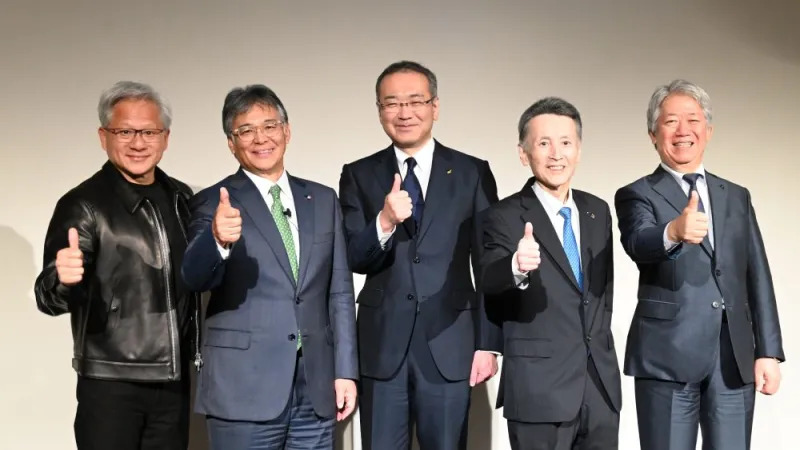
Fujitsu held a press conference in Tokyo on July 16, announcing the start of discussions on joint initiatives in physical AI — a form of AI technology — with FANUC, Yaskawa Electric, and Kawasaki Heavy Industries. Leveraging NVIDIA’s physical AI technologies, the initiative aims to bring a large-scale, Japanese-developed physical AI platform into real-world deployment. NVIDIA CEO Jensen Huang, who traveled to Japan for the event, expressed strong expectations for the project.
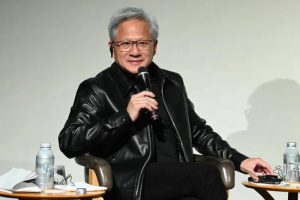
Jensen Huang, CEO of NVIDIA
Fujitsu will lead joint discussions on physical AI initiatives with FANUC, Yaskawa Electric, and Kawasaki Heavy Industries.
Fujitsu will play a central role in the initiative. The platform for coordinated control and task planning, “Fujitsu Kozuchi Physical OS,” seamlessly connects business applications, robot control, and NVIDIA’s physical AI technologies.
Fujitsu Kozuchi will be provided as an open platform for use by each of the robot manufacturers. The platform is already integrated with NVIDIA’s physical AI-related technologies and solutions.
NVIDIA CEO Jensen Huang commented: “The IT revolution was led by the United States, but with physical AI — where AI and physical hardware converge — Japan has the potential to take center stage. Japan is home to some of the world’s leading robot manufacturers and possesses overwhelming mechatronics expertise. Japan should seize this opportunity and move quickly toward implementation.”

Takahito Tokita, President and CEO of Fujitsu
As an immediate next step, Fujitsu will conduct a proof of concept for industrial robot control using the platform at its own factory by the end of September. Following safety verification and other testing, the company plans to begin providing the platform to robot manufacturers by the end of the year. Next year, feedback from the companies will be incorporated as the platform is developed into Version 2.
Takahito Tokita, President and CEO of Fujitsu, said:
“Fujitsu Kozuchi is not a platform we simply release and leave as-is — it is one that will continuously evolve through updates. Going forward, we want to accelerate that evolution through collaboration with robot manufacturers such as FANUC, Yaskawa Electric, and Kawasaki Heavy Industries, and enhance its practical value across a variety of real-world environments.”

Kenji Yamaguchi, President and CEO of FANUC
Robot manufacturers also expressed their enthusiasm for the initiative at the event.
Kenji Yamaguchi, President and CEO of FANUC, stated: “There is a severe labor shortage, and the need for high-mix, low-volume production and autonomous factory operations is growing rapidly. We aim to combine Fujitsu’s AI infrastructure, NVIDIA’s advanced technology, and our own robotics expertise to deliver AI robots that are practical and easy to operate on the shop floor.”

Masahiro Ogawa, Vice Chairman and Executive Officer of Yaskawa Electric
Masahiro Ogawa, Vice Chairman and Executive Officer of Yaskawa Electric, said: “We have already brought autonomous robots equipped with NVIDIA GPUs to market. In addition to the data utilization that has long been central to our approach, a shift is underway toward a new stage in which robots exercise their own intelligence to make autonomous decisions and act. To accelerate this shift, we want to collaborate across company boundaries, even with competitors.”
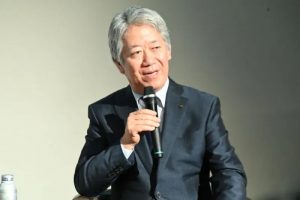
Yasuhiko Hashimoto, President and CEO of Kawasaki Heavy Industries
Yasuhiko Hashimoto, President and CEO of Kawasaki Heavy Industries, offered a concrete vision: “Japan’s aging society means that automation in healthcare — including medical and nursing care — is an urgent necessity, and it is an area we are actively focused on. If our surgical support robots and nursing assistance robots can achieve autonomy through physical AI and integrate with Fujitsu’s medical IT capabilities such as electronic health records, this could become a one-stop solution for hospitals and elderly people who need care.”

Can cross-company collaboration make Fujitsu Kozuchi the de facto standard?
Each of the robot manufacturers has been pursuing the development and application of physical AI in its own way — whether through open platforms, internal development, or other approaches. Where, then, does Fujitsu Kozuchi fit in?
One clue may lie in the comments made by Kawasaki Heavy Industries President and CEO Yasuhiko Hashimoto, who repeatedly emphasized applications in medical and healthcare fields during both his remarks and the Q&A session.
AI technologies have different strengths depending on training data, architectures, and processing capabilities. It is likely that each company will selectively apply different solutions — their own internally developed physical AI, Fujitsu Kozuchi, or other open technologies — depending on the specific robotics field and application.
During the press conference, FANUC President and CEO Yamaguchi referred to “technologies compatible with open platforms such as ROS2 and Python,” while Yaskawa Electric Vice Chairman Ogawa repeatedly emphasized “the importance of use cases.” These comments suggest that future competition among platforms may ultimately be determined by specific applications and implementation results.
Conversely, the period before such differentiation becomes clear may represent a significant opportunity for Fujitsu.
During the press conference, NVIDIA CEO Huang praised Japan’s technological capabilities, but also remarked: “Japan’s stock prices move very fast, so the pace of on-site implementation needs to keep up.” The remark could be interpreted as a reminder that implementation speed will be critical.
Looking back at industrial history, cross-company collaboration platforms have often achieved broad consensus while struggling to maintain execution speed.
How effectively Fujitsu can lead the participating companies and how quickly it can demonstrate tangible progress may ultimately determine whether Fujitsu Kozuchi can become Japan’s de facto standard platform for physical AI.
September 16, 2026
Share On :


